What is the Foundation Programme?
What is the Foundation Programme?

One of the most important transition routes for international students aiming to pursue undergraduate education abroad, the Foundation Programme is an academic preparatory year that prepares the student academically, linguistically and culturally for university study.
Foundation programmes are offered in different structures, particularly in the United Kingdom, Ireland, Australia, New Zealand, the Netherlands, Germany and some European countries. As each country’s education system, admission criteria and visa requirements differ, the Foundation year does not always progress in the same way; however, its core purpose is similar: to enable the student to begin the undergraduate programme they are aiming for on a safer, more prepared and academically sound footing.
This programme is not merely a language course. Depending on the undergraduate field they are targeting, the student takes core academic subjects; they are prepared for academic English, research techniques, presentation skills, essay writing, referencing and the discipline of studying at university level.
When successfully completed, the student may progress to the first year of the relevant undergraduate programme, provided that certain conditions are met.
Why Should You Take Foundation Education?
It Makes the Academic Transition Easier
There may be differences in curriculum, assessment methods and academic expectations between secondary education in Turkey and university entry systems abroad. The Foundation year bridges these differences and enables the student to begin undergraduate study more strongly.
It Prepares You for the Right University and Department
Foundation programmes are generally tailored to the student’s intended field. There are different pathway options for areas such as business, engineering, social sciences, law, health sciences, art and design.
It Improves Academic English Skills
Knowing everyday English alone may not be sufficient for university success. Throughout the Foundation year, the student gains the skills needed in university life, such as essay writing, academic reading, presentation techniques, conducting research and referencing.
It Helps Students Adapt to the University System
Each country has a different academic system. The Foundation programme helps the student become familiar, before starting their undergraduate degree, with the examination, assignment, project, participation and assessment approach of the country in which they will study.
It Can Strategically Increase the Chances of Admission
Some students may not meet the direct entry requirements for the university they are aiming for. When completed with suitable results, the Foundation programme can provide a strong alternative route for the student to progress to their undergraduate degree.
In Which Countries Are Foundation Programmes Valid?
Although Foundation programmes are most commonly known within the United Kingdom education system, they are not exclusive to England. Today, many countries offer similar preparatory and pathway models for international students.
Foundation or similar academic preparatory programmes may be found in the following countries:
United Kingdom: Foundation Year, International Foundation Year and Integrated Foundation models are common.
Ireland: International Foundation Year programmes may be offered by some universities and pathway providers.
Australia: Foundation Studies programmes are widely used to prepare international students for undergraduate education in Australia.
New Zealand: Foundation Studies or Foundation Certificate programmes prepare the student academically and linguistically for undergraduate study.
The Netherlands: Some universities or pathway providers may offer Foundation Year or preparatory year options for students who do not meet direct entry requirements.
Germany and Some European Countries: Programme names and structures may vary by country. In some countries, different systems may exist instead of Foundation, such as preparatory year, pathway, Studienkolleg or bridging programme.
The USA and Canada: Although the word Foundation is not always used in exactly the same sense, pathway, undergraduate preparation, first-year pathway or academic transition programmes may serve a similar function.
For this reason, when planning the Foundation process, not only the country but also the target university, department, the student’s secondary school background, grade point average, language level and visa eligibility should be evaluated together.
Application Requirements and Admission Criteria
The admission process for Foundation programmes varies according to the student’s academic background, target country, preferred university and chosen department. At Solitas Academy, the point we value most in this process is placing the student on the right pathway where they can not only gain admission, but also progress successfully.
1. Academic Qualifications
For applications to Foundation programmes, a secondary school diploma and transcript are generally assessed.
The grade point average of students graduating from public high schools, Anatolian high schools or private high schools is reviewed according to different criteria depending on the country and university to which they are applying. While a range of 60% to 70% may be sufficient for some programmes, higher academic achievement may be expected for more competitive universities and departments.
Not only the overall grade point average, but also the student’s performance in subjects related to their intended field is important. For example, mathematics and physics may be more critical for a student aiming for engineering, while biology and chemistry may be more important for a student aiming for health sciences.
2. Language Proficiency
In Foundation programmes, the student is expected to demonstrate language proficiency at a level appropriate to the language of instruction.
For programmes taught in English, IELTS Academic, IELTS for UKVI, TOEFL, Pearson PTE or other exams accepted by the university may be required. The important point here is that the type of exam must be suitable for the country, institution and visa requirements being applied for.
Particularly in applications to the United Kingdom, depending on the programme level and visa type, specific exam requirements such as IELTS for UKVI may arise. Therefore, it is critically important to guide the student towards the correct type of exam before they sit it.
3. Age Requirement
The age requirement for Foundation programmes may vary depending on the country and institution. While some programmes expect the student to be at least 16 or 17 years old at the start date, different age criteria may apply in other programmes.
4. Programme and Pathway Alignment
The Foundation pathway chosen by the student must be aligned with their undergraduate goal. Choosing the wrong pathway may make it difficult for the student to progress to the desired department at the end of the year. For this reason, the target department should be clarified at the very beginning of the application process.
In Which Fields Can Foundation Education Be Taken?
Foundation programmes are generally divided into different pathway options according to the student’s intended undergraduate field.
Business & Management
Provides preparation for business, economics, marketing, accounting, finance and management.
Engineering & Computing
May include subjects such as mathematics, physics, mechanics, computer science, introduction to programming and engineering fundamentals.
Law & Social Sciences
Provides academic preparation for law, international relations, politics, sociology, psychology and social sciences.
Life Sciences & Health Sciences
May include biology, chemistry, health sciences, psychology and laboratory-based core subjects.
Art & Design
May focus on portfolio preparation, art history, visual communication, design theory and creative project development.
Media, Communication & Humanities
Suitable pathway options may be available for students wishing to study media, communication, literature, cultural studies and the humanities.
Who Can Apply for the Foundation Programme?
The Foundation programme is suitable for students aiming to study for an undergraduate degree abroad and who need additional preparation for direct university admission.
Students Graduating from 12 Years of Secondary Education
For students who have completed secondary school in Turkey but do not meet the direct entry requirements of their target country, the Foundation year can be a strong transition option.
Students Who Have Not Been Part of an International Diploma Programme
Students who have not graduated from international systems such as IB, A-Level or AP may prepare for undergraduate study through a Foundation programme in some countries.
Those Who Wish to Strengthen Their Academic Grades
For students whose secondary school average or subject grades do not meet the direct entry requirements of their target university, the Foundation year can offer an alternative route.
Those Who Wish to Change Field
For students who studied in a different field at secondary school but wish to move into another department at university, the Foundation year can provide an academic transition process.
Those Who Wish to Adapt to an Overseas Education System
Even if their language level is sufficient, the Foundation year is a safe preparation period for students who wish to become accustomed to a different country’s academic system, assignment structure, exam format and university culture.
One of the most important transition routes for international students aiming to pursue undergraduate education abroad, the Foundation Programme is an academic preparatory year that prepares the student academically, linguistically and culturally for university study.
Foundation programmes are offered in different structures, particularly in the United Kingdom, Ireland, Australia, New Zealand, the Netherlands, Germany and some European countries. As each country’s education system, admission criteria and visa requirements differ, the Foundation year does not always progress in the same way; however, its core purpose is similar: to enable the student to begin the undergraduate programme they are aiming for on a safer, more prepared and academically sound footing.
This programme is not merely a language course. Depending on the undergraduate field they are targeting, the student takes core academic subjects; they are prepared for academic English, research techniques, presentation skills, essay writing, referencing and the discipline of studying at university level.
When successfully completed, the student may progress to the first year of the relevant undergraduate programme, provided that certain conditions are met.
Why Should You Take Foundation Education?
It Makes the Academic Transition Easier
There may be differences in curriculum, assessment methods and academic expectations between secondary education in Turkey and university entry systems abroad. The Foundation year bridges these differences and enables the student to begin undergraduate study more strongly.
It Prepares You for the Right University and Department
Foundation programmes are generally tailored to the student’s intended field. There are different pathway options for areas such as business, engineering, social sciences, law, health sciences, art and design.
It Improves Academic English Skills
Knowing everyday English alone may not be sufficient for university success. Throughout the Foundation year, the student gains the skills needed in university life, such as essay writing, academic reading, presentation techniques, conducting research and referencing.
It Helps Students Adapt to the University System
Each country has a different academic system. The Foundation programme helps the student become familiar, before starting their undergraduate degree, with the examination, assignment, project, participation and assessment approach of the country in which they will study.
It Can Strategically Increase the Chances of Admission
Some students may not meet the direct entry requirements for the university they are aiming for. When completed with suitable results, the Foundation programme can provide a strong alternative route for the student to progress to their undergraduate degree.
In Which Countries Are Foundation Programmes Valid?
Although Foundation programmes are most commonly known within the United Kingdom education system, they are not exclusive to England. Today, many countries offer similar preparatory and pathway models for international students.
Foundation or similar academic preparatory programmes may be found in the following countries:
United Kingdom: Foundation Year, International Foundation Year and Integrated Foundation models are common.
Ireland: International Foundation Year programmes may be offered by some universities and pathway providers.
Australia: Foundation Studies programmes are widely used to prepare international students for undergraduate education in Australia.
New Zealand: Foundation Studies or Foundation Certificate programmes prepare the student academically and linguistically for undergraduate study.
The Netherlands: Some universities or pathway providers may offer Foundation Year or preparatory year options for students who do not meet direct entry requirements.
Germany and Some European Countries: Programme names and structures may vary by country. In some countries, different systems may exist instead of Foundation, such as preparatory year, pathway, Studienkolleg or bridging programme.
The USA and Canada: Although the word Foundation is not always used in exactly the same sense, pathway, undergraduate preparation, first-year pathway or academic transition programmes may serve a similar function.
For this reason, when planning the Foundation process, not only the country but also the target university, department, the student’s secondary school background, grade point average, language level and visa eligibility should be evaluated together.
Application Requirements and Admission Criteria
The admission process for Foundation programmes varies according to the student’s academic background, target country, preferred university and chosen department. At Solitas Academy, the point we value most in this process is placing the student on the right pathway where they can not only gain admission, but also progress successfully.
1. Academic Qualifications
For applications to Foundation programmes, a secondary school diploma and transcript are generally assessed.
The grade point average of students graduating from public high schools, Anatolian high schools or private high schools is reviewed according to different criteria depending on the country and university to which they are applying. While a range of 60% to 70% may be sufficient for some programmes, higher academic achievement may be expected for more competitive universities and departments.
Not only the overall grade point average, but also the student’s performance in subjects related to their intended field is important. For example, mathematics and physics may be more critical for a student aiming for engineering, while biology and chemistry may be more important for a student aiming for health sciences.
2. Language Proficiency
In Foundation programmes, the student is expected to demonstrate language proficiency at a level appropriate to the language of instruction.
For programmes taught in English, IELTS Academic, IELTS for UKVI, TOEFL, Pearson PTE or other exams accepted by the university may be required. The important point here is that the type of exam must be suitable for the country, institution and visa requirements being applied for.
Particularly in applications to the United Kingdom, depending on the programme level and visa type, specific exam requirements such as IELTS for UKVI may arise. Therefore, it is critically important to guide the student towards the correct type of exam before they sit it.
3. Age Requirement
The age requirement for Foundation programmes may vary depending on the country and institution. While some programmes expect the student to be at least 16 or 17 years old at the start date, different age criteria may apply in other programmes.
4. Programme and Pathway Alignment
The Foundation pathway chosen by the student must be aligned with their undergraduate goal. Choosing the wrong pathway may make it difficult for the student to progress to the desired department at the end of the year. For this reason, the target department should be clarified at the very beginning of the application process.
In Which Fields Can Foundation Education Be Taken?
Foundation programmes are generally divided into different pathway options according to the student’s intended undergraduate field.
Business & Management
Provides preparation for business, economics, marketing, accounting, finance and management.
Engineering & Computing
May include subjects such as mathematics, physics, mechanics, computer science, introduction to programming and engineering fundamentals.
Law & Social Sciences
Provides academic preparation for law, international relations, politics, sociology, psychology and social sciences.
Life Sciences & Health Sciences
May include biology, chemistry, health sciences, psychology and laboratory-based core subjects.
Art & Design
May focus on portfolio preparation, art history, visual communication, design theory and creative project development.
Media, Communication & Humanities
Suitable pathway options may be available for students wishing to study media, communication, literature, cultural studies and the humanities.
Who Can Apply for the Foundation Programme?
The Foundation programme is suitable for students aiming to study for an undergraduate degree abroad and who need additional preparation for direct university admission.
Students Graduating from 12 Years of Secondary Education
For students who have completed secondary school in Turkey but do not meet the direct entry requirements of their target country, the Foundation year can be a strong transition option.
Students Who Have Not Been Part of an International Diploma Programme
Students who have not graduated from international systems such as IB, A-Level or AP may prepare for undergraduate study through a Foundation programme in some countries.
Those Who Wish to Strengthen Their Academic Grades
For students whose secondary school average or subject grades do not meet the direct entry requirements of their target university, the Foundation year can offer an alternative route.
Those Who Wish to Change Field
For students who studied in a different field at secondary school but wish to move into another department at university, the Foundation year can provide an academic transition process.
Those Who Wish to Adapt to an Overseas Education System
Even if their language level is sufficient, the Foundation year is a safe preparation period for students who wish to become accustomed to a different country’s academic system, assignment structure, exam format and university culture.
One of the most important transition routes for international students aiming to pursue undergraduate education abroad, the Foundation Programme is an academic preparatory year that prepares the student academically, linguistically and culturally for university study.
Foundation programmes are offered in different structures, particularly in the United Kingdom, Ireland, Australia, New Zealand, the Netherlands, Germany and some European countries. As each country’s education system, admission criteria and visa requirements differ, the Foundation year does not always progress in the same way; however, its core purpose is similar: to enable the student to begin the undergraduate programme they are aiming for on a safer, more prepared and academically sound footing.
This programme is not merely a language course. Depending on the undergraduate field they are targeting, the student takes core academic subjects; they are prepared for academic English, research techniques, presentation skills, essay writing, referencing and the discipline of studying at university level.
When successfully completed, the student may progress to the first year of the relevant undergraduate programme, provided that certain conditions are met.
Why Should You Take Foundation Education?
It Makes the Academic Transition Easier
There may be differences in curriculum, assessment methods and academic expectations between secondary education in Turkey and university entry systems abroad. The Foundation year bridges these differences and enables the student to begin undergraduate study more strongly.
It Prepares You for the Right University and Department
Foundation programmes are generally tailored to the student’s intended field. There are different pathway options for areas such as business, engineering, social sciences, law, health sciences, art and design.
It Improves Academic English Skills
Knowing everyday English alone may not be sufficient for university success. Throughout the Foundation year, the student gains the skills needed in university life, such as essay writing, academic reading, presentation techniques, conducting research and referencing.
It Helps Students Adapt to the University System
Each country has a different academic system. The Foundation programme helps the student become familiar, before starting their undergraduate degree, with the examination, assignment, project, participation and assessment approach of the country in which they will study.
It Can Strategically Increase the Chances of Admission
Some students may not meet the direct entry requirements for the university they are aiming for. When completed with suitable results, the Foundation programme can provide a strong alternative route for the student to progress to their undergraduate degree.
In Which Countries Are Foundation Programmes Valid?
Although Foundation programmes are most commonly known within the United Kingdom education system, they are not exclusive to England. Today, many countries offer similar preparatory and pathway models for international students.
Foundation or similar academic preparatory programmes may be found in the following countries:
United Kingdom: Foundation Year, International Foundation Year and Integrated Foundation models are common.
Ireland: International Foundation Year programmes may be offered by some universities and pathway providers.
Australia: Foundation Studies programmes are widely used to prepare international students for undergraduate education in Australia.
New Zealand: Foundation Studies or Foundation Certificate programmes prepare the student academically and linguistically for undergraduate study.
The Netherlands: Some universities or pathway providers may offer Foundation Year or preparatory year options for students who do not meet direct entry requirements.
Germany and Some European Countries: Programme names and structures may vary by country. In some countries, different systems may exist instead of Foundation, such as preparatory year, pathway, Studienkolleg or bridging programme.
The USA and Canada: Although the word Foundation is not always used in exactly the same sense, pathway, undergraduate preparation, first-year pathway or academic transition programmes may serve a similar function.
For this reason, when planning the Foundation process, not only the country but also the target university, department, the student’s secondary school background, grade point average, language level and visa eligibility should be evaluated together.
Application Requirements and Admission Criteria
The admission process for Foundation programmes varies according to the student’s academic background, target country, preferred university and chosen department. At Solitas Academy, the point we value most in this process is placing the student on the right pathway where they can not only gain admission, but also progress successfully.
1. Academic Qualifications
For applications to Foundation programmes, a secondary school diploma and transcript are generally assessed.
The grade point average of students graduating from public high schools, Anatolian high schools or private high schools is reviewed according to different criteria depending on the country and university to which they are applying. While a range of 60% to 70% may be sufficient for some programmes, higher academic achievement may be expected for more competitive universities and departments.
Not only the overall grade point average, but also the student’s performance in subjects related to their intended field is important. For example, mathematics and physics may be more critical for a student aiming for engineering, while biology and chemistry may be more important for a student aiming for health sciences.
2. Language Proficiency
In Foundation programmes, the student is expected to demonstrate language proficiency at a level appropriate to the language of instruction.
For programmes taught in English, IELTS Academic, IELTS for UKVI, TOEFL, Pearson PTE or other exams accepted by the university may be required. The important point here is that the type of exam must be suitable for the country, institution and visa requirements being applied for.
Particularly in applications to the United Kingdom, depending on the programme level and visa type, specific exam requirements such as IELTS for UKVI may arise. Therefore, it is critically important to guide the student towards the correct type of exam before they sit it.
3. Age Requirement
The age requirement for Foundation programmes may vary depending on the country and institution. While some programmes expect the student to be at least 16 or 17 years old at the start date, different age criteria may apply in other programmes.
4. Programme and Pathway Alignment
The Foundation pathway chosen by the student must be aligned with their undergraduate goal. Choosing the wrong pathway may make it difficult for the student to progress to the desired department at the end of the year. For this reason, the target department should be clarified at the very beginning of the application process.
In Which Fields Can Foundation Education Be Taken?
Foundation programmes are generally divided into different pathway options according to the student’s intended undergraduate field.
Business & Management
Provides preparation for business, economics, marketing, accounting, finance and management.
Engineering & Computing
May include subjects such as mathematics, physics, mechanics, computer science, introduction to programming and engineering fundamentals.
Law & Social Sciences
Provides academic preparation for law, international relations, politics, sociology, psychology and social sciences.
Life Sciences & Health Sciences
May include biology, chemistry, health sciences, psychology and laboratory-based core subjects.
Art & Design
May focus on portfolio preparation, art history, visual communication, design theory and creative project development.
Media, Communication & Humanities
Suitable pathway options may be available for students wishing to study media, communication, literature, cultural studies and the humanities.
Who Can Apply for the Foundation Programme?
The Foundation programme is suitable for students aiming to study for an undergraduate degree abroad and who need additional preparation for direct university admission.
Students Graduating from 12 Years of Secondary Education
For students who have completed secondary school in Turkey but do not meet the direct entry requirements of their target country, the Foundation year can be a strong transition option.
Students Who Have Not Been Part of an International Diploma Programme
Students who have not graduated from international systems such as IB, A-Level or AP may prepare for undergraduate study through a Foundation programme in some countries.
Those Who Wish to Strengthen Their Academic Grades
For students whose secondary school average or subject grades do not meet the direct entry requirements of their target university, the Foundation year can offer an alternative route.
Those Who Wish to Change Field
For students who studied in a different field at secondary school but wish to move into another department at university, the Foundation year can provide an academic transition process.
Those Who Wish to Adapt to an Overseas Education System
Even if their language level is sufficient, the Foundation year is a safe preparation period for students who wish to become accustomed to a different country’s academic system, assignment structure, exam format and university culture.
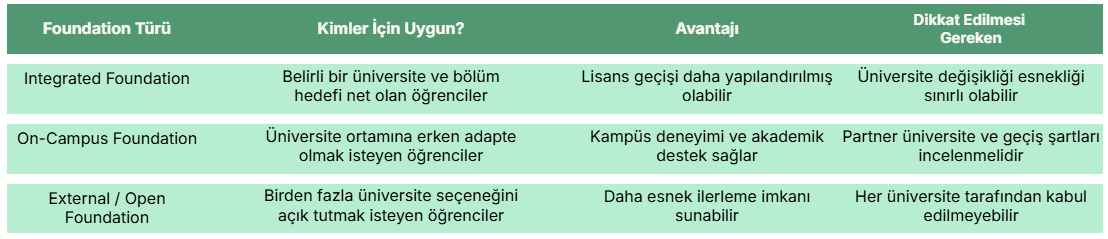
Foundation Types: Differences Between Integrated, On-Campus and External Pathway
Foundation programmes are not offered in the same structure in every country. Depending on the student’s target country, university, department and visa status, different Foundation models may be preferred.
1. Integrated Foundation
Integrated Foundation is generally a preparation model offered within the university itself and progressing in connection with undergraduate education. When the student begins the Foundation year, they are often planned to progress to an undergraduate programme at the same university, provided they meet certain achievement requirements.
Advantages
From the first day, the student experiences an environment closer to university life.
They can benefit from campus facilities, academic resources and student support services.
The transition process to the undergraduate programme may be clearer and more structured.
In some countries, the visa and admission process may progress in a more integrated way.
Points to Consider
Integrated Foundation is usually linked to a specific university or programme. Therefore, if the student wishes to transfer to different universities at the end of the year, their options may be limited.
2. On-Campus Foundation
On-Campus Foundation is often offered on a university campus or by pathway providers working in partnership with the university. While the student receives education in the university environment, they are academically prepared for undergraduate study.
Advantages
It provides early adaptation to the university campus.
Academic and personal support for international students may be more structured.
The progression requirements to the partner university are usually clear from the outset.
The student is prepared for university life both academically and socially.
Points to Consider
The universities to which the programme offers progression, the minimum grades required for progression and department-specific conditions must be examined in detail.
3. External / Open Foundation
External or Open Foundation programmes are not entirely tied to a single university and may offer the opportunity to progress to different universities. They may be offered by some private educational institutions, colleges or international pathway providers.
Advantages
It may be a more flexible option for students who do not want to be tied to a single university.
At the end of the Foundation year, the student may apply to different universities based on the achievement they have obtained.
Some programmes may offer a broad network of partner universities.
The class structure and student support may be more intensive for international students.
Points to Consider
Not every university may accept every external foundation programme.
Whether this programme is recognised for the student’s target department and university should be checked from the outset.
The visa process may progress separately depending on the country and the programme.
Important Technical Details in Foundation Education
Progression Requirements
Completing the Foundation programme alone does not always mean automatic progression to undergraduate study. The student may need to meet a certain grade point average, subject-based achievement, language score or portfolio requirement.
For example, progression requirements may be higher in competitive fields such as law, engineering, medicine, health sciences or architecture. As Solitas Academy, we assess not only the student’s admission to the programme, but also their likelihood of progressing safely to undergraduate study at the end of the year.
Language Test Selection
Each country and institution may accept different language tests. IELTS Academic, IELTS for UKVI, TOEFL, PTE Academic or university-specific English tests may come into consideration.
Taking the wrong test can lead to a loss of time in the application or visa process. Therefore, the most appropriate test type should be determined in advance according to the student’s target country and the programme they will apply for.
Visa and Admission Documents
The visa process varies by country. In the United Kingdom, a CAS document, in Australia a CoE, and in New Zealand and European countries different admission and visa documents may be required.
Therefore, a Foundation application is not limited to school admission alone. The education plan, visa eligibility, financial documents, age requirement, accommodation and progression plan must all be considered together.
University Recognition
Not every Foundation programme is accepted by every university. Especially in external pathway programmes, it must be checked whether the student’s target university recognises this programme.
This point is critically important for the student’s future undergraduate progression.
Comparison Table
Foundation Types: Differences Between Integrated, On-Campus and External Pathway
Foundation programmes are not offered in the same structure in every country. Depending on the student’s target country, university, department and visa status, different Foundation models may be preferred.
1. Integrated Foundation
Integrated Foundation is generally a preparation model offered within the university itself and progressing in connection with undergraduate education. When the student begins the Foundation year, they are often planned to progress to an undergraduate programme at the same university, provided they meet certain achievement requirements.
Advantages
From the first day, the student experiences an environment closer to university life.
They can benefit from campus facilities, academic resources and student support services.
The transition process to the undergraduate programme may be clearer and more structured.
In some countries, the visa and admission process may progress in a more integrated way.
Points to Consider
Integrated Foundation is usually linked to a specific university or programme. Therefore, if the student wishes to transfer to different universities at the end of the year, their options may be limited.
2. On-Campus Foundation
On-Campus Foundation is often offered on a university campus or by pathway providers working in partnership with the university. While the student receives education in the university environment, they are academically prepared for undergraduate study.
Advantages
It provides early adaptation to the university campus.
Academic and personal support for international students may be more structured.
The progression requirements to the partner university are usually clear from the outset.
The student is prepared for university life both academically and socially.
Points to Consider
The universities to which the programme offers progression, the minimum grades required for progression and department-specific conditions must be examined in detail.
3. External / Open Foundation
External or Open Foundation programmes are not entirely tied to a single university and may offer the opportunity to progress to different universities. They may be offered by some private educational institutions, colleges or international pathway providers.
Advantages
It may be a more flexible option for students who do not want to be tied to a single university.
At the end of the Foundation year, the student may apply to different universities based on the achievement they have obtained.
Some programmes may offer a broad network of partner universities.
The class structure and student support may be more intensive for international students.
Points to Consider
Not every university may accept every external foundation programme.
Whether this programme is recognised for the student’s target department and university should be checked from the outset.
The visa process may progress separately depending on the country and the programme.
Important Technical Details in Foundation Education
Progression Requirements
Completing the Foundation programme alone does not always mean automatic progression to undergraduate study. The student may need to meet a certain grade point average, subject-based achievement, language score or portfolio requirement.
For example, progression requirements may be higher in competitive fields such as law, engineering, medicine, health sciences or architecture. As Solitas Academy, we assess not only the student’s admission to the programme, but also their likelihood of progressing safely to undergraduate study at the end of the year.
Language Test Selection
Each country and institution may accept different language tests. IELTS Academic, IELTS for UKVI, TOEFL, PTE Academic or university-specific English tests may come into consideration.
Taking the wrong test can lead to a loss of time in the application or visa process. Therefore, the most appropriate test type should be determined in advance according to the student’s target country and the programme they will apply for.
Visa and Admission Documents
The visa process varies by country. In the United Kingdom, a CAS document, in Australia a CoE, and in New Zealand and European countries different admission and visa documents may be required.
Therefore, a Foundation application is not limited to school admission alone. The education plan, visa eligibility, financial documents, age requirement, accommodation and progression plan must all be considered together.
University Recognition
Not every Foundation programme is accepted by every university. Especially in external pathway programmes, it must be checked whether the student’s target university recognises this programme.
This point is critically important for the student’s future undergraduate progression.
Comparison Table
Types of Foundation: Differences Between Integrated and External
When undertaking preparatory education in the UK, the most critical choice you will encounter is the structural type of the programme. Both models have their own advantages and visa procedures. Solitas Academy helps you make the most appropriate match according to the student's academic goals.
1. Integrated (Combined) Foundation
This programme is a model offered within the university itself and directly combined with undergraduate study. The offer letter given to the student usually covers a single 4-year package, typically in the form of 1 year of foundation + 3 years of undergraduate study.
Visa Advantage: The student receives a single visa (CAS document) for the entire period of study. There is no need to deal with annual visa renewals.
Campus Experience: From day one, the student is an official university student; they benefit from the library, gym and accommodation facilities with the same rights as other students.
Work Permit: Generally allows students to work up to 20 hours per week (because it is within the university).
Progression Requirement: Generally, successfully completing the programme (Pass) is sufficient; no further application process is required.
2. External / Open Foundation
These programmes are offered by providers not affiliated with a university or by private education groups (such as Kaplan, Study Group, INTO). These programmes may be delivered on a specific university campus or at independent colleges.
Flexibility: Ideal for students who do not want to be tied to a single university and who wish to apply to the UK's top 5-10 universities (top-tier) based on their end-of-year performance.
Intensive Support: Class sizes are usually smaller, and the individual academic support provided to international students is much more extensive.
Visa Status: Generally, only a 1-year visa is issued. The student must renew their visa at the end of the course for undergraduate study.
University Options: Upon successful completion, it offers the opportunity to progress to dozens of different universities with partnership agreements.
Important Technical Details in Foundation Education
In this section of our website, we address some critical concepts that demonstrate our level of expertise:
CAS Document and Visa (Student Visa)
In order to study in the UK, a CAS (Confirmation of Acceptance for Studies) document issued by the university is required. While a single CAS document covers the entire process in integrated programmes, a new CAS document is requested for undergraduate study once the foundation is completed in external programmes.
Progress Requirements
At the end of each Foundation programme, there is a "Progress" score. For example, a student who wants to study law may be required to complete the foundation year with an average of 70%. Solitas Academy assesses the student's capacity and directs them to programmes where they can pass these thresholds in the safest way possible.
Difference with IELTS for UKVI
The most important technical detail not to forget is this: for preparatory-level (Level 0/3) courses, a standard IELTS result is not sufficient; a IELTS for UKVI exam result is absolutely required. This is a legal requirement for the visa application.
Comparison Table
Feature
Feature
Feature
Feature
Visa Duration
Visa Duration
Visa Duration
Visa Duration
Student Duration
Student Duration
Student Duration
Student Duration
Work Permit
Work Permit
Work Permit
Work Permit
Solitas Academy Farkı ile Foundation Süreci
Foundation yılı, öğrencinin yurt dışı eğitim yolculuğunda yalnızca bir hazırlık dönemi değil, doğru üniversite ve kariyer planının temelidir.
Solitas Academy olarak öğrencinin akademik geçmişini, hedef bölümünü, ülke tercihini, dil seviyesini ve uzun vadeli kariyer hedeflerini birlikte değerlendiriyoruz. Amacımız öğrenciyi sadece kabul alabileceği bir programa yerleştirmek değil; başarıyla tamamlayabileceği, lisans eğitimine güvenle geçebileceği ve gelecekteki kariyerini destekleyecek doğru akademik yola yönlendirmektir.
Her öğrencinin profili farklıdır. Bu yüzden Foundation sürecinde tek bir doğru yoktur; doğru ülke, doğru pathway, doğru üniversite ve doğru başvuru stratejisi vardır.
Unutmayın: Foundation yılı kayıp bir yıl değil; yurt dışı üniversite eğitiminizin en sağlam akademik temelidir.
Solitas Academy Farkı ile Foundation Süreci
Foundation yılı, öğrencinin yurt dışı eğitim yolculuğunda yalnızca bir hazırlık dönemi değil, doğru üniversite ve kariyer planının temelidir.
Solitas Academy olarak öğrencinin akademik geçmişini, hedef bölümünü, ülke tercihini, dil seviyesini ve uzun vadeli kariyer hedeflerini birlikte değerlendiriyoruz. Amacımız öğrenciyi sadece kabul alabileceği bir programa yerleştirmek değil; başarıyla tamamlayabileceği, lisans eğitimine güvenle geçebileceği ve gelecekteki kariyerini destekleyecek doğru akademik yola yönlendirmektir.
Her öğrencinin profili farklıdır. Bu yüzden Foundation sürecinde tek bir doğru yoktur; doğru ülke, doğru pathway, doğru üniversite ve doğru başvuru stratejisi vardır.
Unutmayın: Foundation yılı kayıp bir yıl değil; yurt dışı üniversite eğitiminizin en sağlam akademik temelidir.